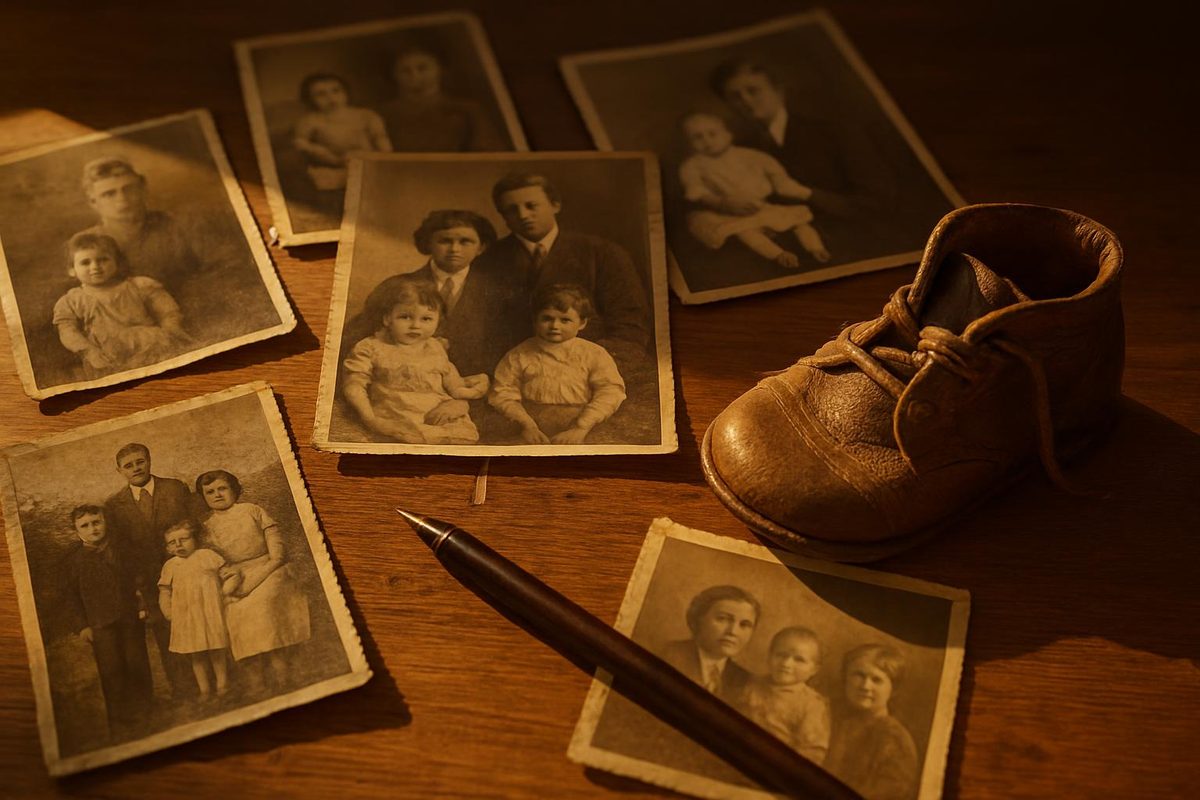
A parenting memoir isn't really about your children. It's about who you became while raising them. That shift in framing — from your kids as the subject to yourself as the subject — is the single most important thing to understand before you start writing. Your children's story belongs to them. What belongs to you is the story of what parenthood did to you: the person you were forced to become, the things you discovered you were capable of, and the ways that nothing you thought you knew prepared you for what showed up.
To write a memoir about raising children well, you need to hold two things at once: deep honesty about your own experience, and real responsibility toward the people who will someday read what you wrote about them. That tension is the craft challenge at the heart of this particular book.
Here's how to navigate it.
What's in This Post
Whose Story Is This? Getting the Framing Right
Most parenting memoirs go wrong in the first chapter by centering the wrong person. The author writes their children as protagonists — describing what the children did, said, achieved, struggled with — and positions themselves as a supporting character in their kids' lives. The result is a scrapbook, not a memoir. Warm, often beautifully detailed, but without the interior life and personal transformation that make memoir worth reading.
Your children are not the main character of your memoir. You are. Your children are the crucible. They're the force that changed you, revealed you, undid you and rebuilt you. They're the most important relationship in the book. But the book is still about what happened inside you as a result of that relationship.
This framing also protects your children. The more the memoir centers your interior experience — your fears, your failures, your discoveries about yourself — the less it exposes them. You can be completely honest about the experience of parenting without making your children's private lives the material.
What You're Really Documenting
Think about what actually changed in you. Not what you did as a parent — what parenthood did to you.
Most people who raise children are genuinely surprised by at least a few things: how much they were capable of loving someone. How much fear came with that love — a fear unlike anything they'd felt before, because now there was something in the world they couldn't protect with certainty. How much of their own childhood surfaced, unbidden, in the moments of crisis and joy. How they became, sometimes without noticing, a different person than the one who started.
That documentation — of transformation, of revelation, of the gap between who you thought you'd be as a parent and who you actually were — is what makes a parenting memoir. It's also, as it happens, what allows people who are not parents to read and be moved by it. The specifics are yours. The experience of being changed by responsibility for another human being is universal.
Writing Your Kids Without Making Them Characters
Your children are real people. They will, in most cases, read what you've written about them at some point in their lives. This is not a reason to avoid writing honestly — it's a reason to write with precision about the distinction between your experience and theirs.
When you write about a moment with your child, the question to keep asking yourself is: whose interior am I writing? You have full access to your own thoughts, fears, reactions, and realizations in any moment. You have only the observable surface of your child — what they said, what they did, how they looked. That's all you're entitled to write.
Don't narrate what your child was feeling or thinking. You don't know. You can write what you observed and what you assumed or feared they felt — being clear that this was your interpretation, not their reported experience. That honesty is both ethically correct and, as it happens, better writing. Uncertainty is more interesting than false certainty.
For a deeper look at the ethics and craft of writing about people in your life, How Do I Write About Living People in My Memoir? is essential reading before you start.
Ready to Write This With a System That Works?
A parenting memoir has specific structural challenges — arc, time compression, writing living people responsibly. How To Write A Memoir: Step-By-Step gives you the complete framework to handle all of it and come out the other side with a manuscript worth handing to your family.
Get the Book + Workbook →Writing the Hard Stuff — Fear, Failure, Resentment
The parenting memoir that only records the beautiful moments isn't honest — and most readers can feel that. Real parenting involves exhaustion, confusion, failure, and occasionally resentment. The moments you weren't the parent you wanted to be. The days that didn't look anything like the vision you had before they arrived. The sacrifices that were harder to make than you expected, and the ones that turned out to be no sacrifice at all.
Writing those things is not a betrayal of your children. It's a record of what it actually meant to love them — which includes everything love costs. The reader who needs this book is not looking for proof that parenthood is beautiful. They already know it's beautiful. They need someone to tell the truth about how hard it is, too, so they feel less alone in their own experience of it.
This same principle applies to marital stress, financial strain, geographic upheaval — all the things that surround the parenting years. You can write about difficulty without making your child the source of it. The difficulty is part of the story. The child is not the problem to be written about.
They Will Read This. Write It Anyway.
Here's what I've found in studying the memoirs that endure: the ones that last are the honest ones. Not the ones that were careful to the point of blandness, not the ones that protected everyone's feelings at the cost of truth — the ones where a person actually showed up on the page and said what it was like.
Your children, when they read this book as adults, don't want a mythology. They want to know who their parent actually was. What you were afraid of. What you didn't know. How you tried. What it cost you. That honest account — even with its imperfections, even with its moments of failure — is a greater gift than a polished version that leaves them wondering what was real.
There is a meaningful difference between writing about yourself with honesty and writing about your children with exposure. Hold that distinction carefully. Be fully honest about yourself. Be protective, without being dishonest, about them. That combination is entirely possible, and it produces the best parenting memoirs.
If some of what you write is intended specifically for them — as a record to be read one day — How to Write a Memoir for Grandchildren has useful guidance on writing with a specific family audience in mind.
How to Structure a Parenting Memoir
Parenting memoir has a structural challenge that most other memoirs don't: the subject covers years, sometimes decades, and much of it is routine. The ordinary days that make up childhood — the meals, the school runs, the bedtime routines — are where the relationship actually lives, but they resist the scene-by-scene approach that memoir typically requires.
The answer is compression and selection. You don't write every day. You write the days that concentrated something — the moments when something changed, broke, clarified, or arrived. A good parenting memoir is built from a relatively small number of fully-rendered scenes, connected by summary that moves the reader through the time in between.
Think about what you're doing when you look back across the years of raising someone: you select the moments that mattered. That selection — made intuitively, from memory — is your structural instinct already at work. Trust it. The moments you keep returning to are probably the ones the memoir needs.
For practical guidance on managing time compression across a long-span memoir, What to Include in Your Memoir gives a useful framework for making those selection decisions intentionally.
Finding the Arc in All the Ordinary Days
Every memoir needs an arc — a change in the narrator from the beginning of the book to the end. In a parenting memoir, that arc is almost always available, because raising children changes you whether you planned for it or not.
The question is naming it clearly enough to shape the book around it. What did you believe about yourself, or about what parenthood would be, at the beginning — and what do you understand now that you didn't then? That gap is your arc. Everything in the book should either build toward the change or document what it was like to be inside it.
"What you're really writing is not the story of raising a child. You're writing the story of a person who was raised — again — by the experience of raising one."
The most honest parenting memoirs are not celebrations of what a great parent the author was. They're accounts of how parenthood undid the person who showed up for it and rebuilt them into someone they hadn't expected to become. That's a story worth telling. That's a story the reader will recognize, regardless of the specific details, because transformation by responsibility is one of the oldest human narratives there is.
Start there. Write from inside your own experience. Be honest about what it cost and what it gave you. Trust the reader to find themselves in your story. That's the book your family — and everyone else who reads it — will keep.
Not sure whether to write it yourself or have it written for you? Take the two-minute memoir path quiz.
The Story of How You Raised Them Deserves to Be Written Right
A parenting memoir is one of the most lasting gifts you can give your family. How To Write A Memoir: Step-By-Step gives you the complete system — structure, arc, voice, and the craft to write living people honestly — so this story gets the book it deserves.
Get the Book + Workbook →