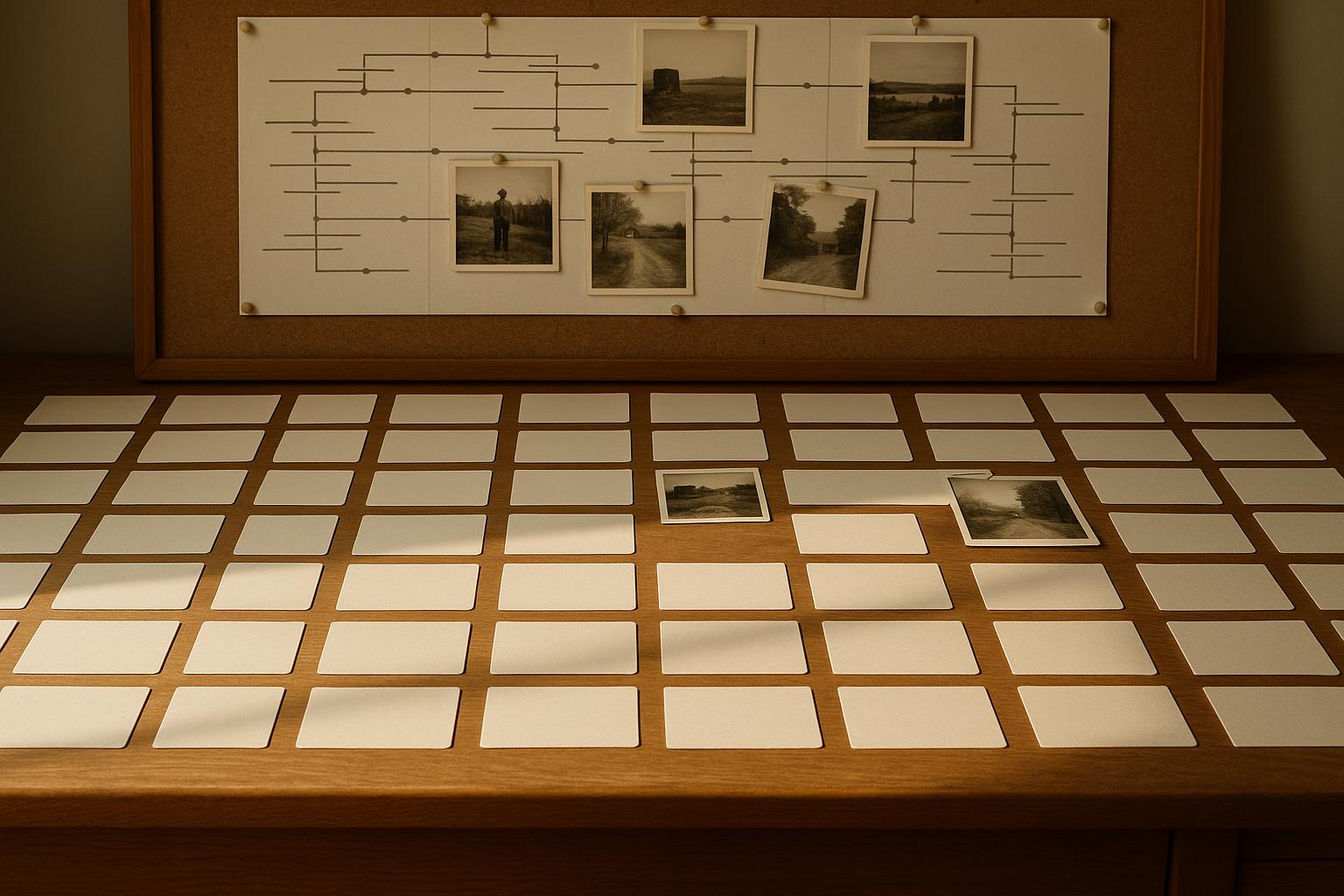
The best way to organize a memoir is to know what it's about before you decide how to order it. That sounds obvious. It rarely is. Most writers approach organization as a sequencing problem — do I go chronological or not? — when the real question is: what is this story actually tracking? Once you answer that, the organization almost decides itself.
You have three primary structures to choose from: chronological, thematic, and braided. Each works. Each fails in the wrong hands. This post gives you a framework for choosing, plus the practical steps for getting your scenes in order once you do.
Table of Contents
What Are the Three Memoir Structures?
Before you can organize your memoir, you need to understand what your options actually are. There's more nuance inside each of these than most writing advice admits.
1. Chronological
Chronological doesn't mean starting at birth. It means the story moves forward in time — your narrative present, your through-line, progresses from an earlier state to a later one.
This is the most natural structure for most people, and it works extremely well when the transformation you're writing about happened in sequence — when the things that changed you built on each other in order. A memoir about a season of grief. A year living abroad. A career collapse and rebuilding. These work chronologically because the shape of the experience was itself linear.
The mistake people make: starting too early. Chronological doesn't mean "everything from the beginning." It means starting at the moment the story begins — which is almost never the moment you were born, and often isn't even the moment the central event started. It's the moment your life was already in motion toward something.
2. Thematic
Thematic organization groups scenes and chapters by subject or idea rather than by when they happened. You might have one chapter about your relationship with your father — drawing on memories from childhood, adolescence, and adulthood — followed by a chapter about work, following the same pattern.
This structure works when the transformation you're tracking is best understood through lenses, not through timeline. Mary Karr's The Liar's Club uses elements of this. So does Roxane Gay's Hunger. The power isn't in what happened when — it's in what each theme reveals about the whole.
The risk: thematic memoirs are hard to write and harder to read if the emotional arc gets lost. Without a narrative spine, readers lose their footing. If you go thematic, you need to be ruthless about making sure each chapter still moves the reader forward emotionally, even if not chronologically.
3. Braided
A braided memoir weaves two or more timelines together — typically a past story and a present story — cutting between them in a way that creates meaning through contrast or convergence. You write yourself navigating something in the present while also narrating the past events that explain why the present matters.
This is one of the most powerful memoir structures when executed well, because it creates instant dramatic irony. The reader knows you survived the past (you're here now, telling it), but the present storyline creates its own tension. The two threads comment on each other.
How Do You Choose the Right Structure?
Ask yourself one question: Is the shape of my experience itself the story?
If yes — if the thing you're writing about unfolded over time in a way that shaped you, and the sequence matters — go chronological. The arc of the experience is the arc of the book.
If no — if you're writing about something more diffuse, a theme that runs through decades, an identity that was built or broken in ways that don't map neatly onto a timeline — consider thematic or braided.
A few more questions to help you decide:
- Do I have a clear "before" and "after"? If yes, chronological probably works. The before-and-after transformation is the arc.
- Is the central insight something I understand now that I didn't then? If yes, braided is worth considering — the present-day narrator looking back is a built-in structural asset.
- Am I writing about a theme that cuts across my whole life, not just a chapter of it? If yes, thematic may serve you better.
And if you're still not sure: start chronological. You can always restructure later. You cannot draft a braided memoir if you don't know what both threads are yet. Get the story out first, in order — then decide if it needs to be reorganized.
Why Do You Organize Scenes, Not Chapters?
This is the thing most memoir advice skips, and it's the thing that will save you the most time.
Chapters are containers. Scenes are the thing inside. If you try to organize your memoir at the chapter level before you've identified your scenes, you're arranging boxes before you know what's going in them.
Here's the process that actually works:
Step 1: List your scenes, not your events. A scene is a specific moment — a particular day, conversation, or confrontation — rendered with sensory detail, dialogue, and emotional stakes. An event is something that happened. "My father's illness" is an event. "The night he called to tell me the diagnosis, and I said the wrong thing and couldn't call back for three days" is a scene.
Write down every scene that belongs in your memoir. Don't edit yet. Just list them. You'll probably end up with 30–60 for a full memoir.
Step 2: Identify your arc. Which of these scenes represents the beginning of the transformation you're writing about? Which represents the turning point? Which represents the end — not the final event, but the moment when you understood what had happened to you?
These three scenes are your anchors: opening, midpoint, close. Everything else slots in around them.
Step 3: Ask of each scene: does this move the arc forward? If a scene doesn't change something — doesn't reveal character, shift the emotional stakes, or advance the central question — it probably doesn't belong in the book. Not because it's unimportant to you, but because memoir isn't a record of your life. It's a shaped story about a particular transformation.
Internal links for more on this: How to Structure Your Memoir in 10 Stages and How to Find Your Memoir's Theme.
The System That Does the Organizing for You
MemoirMaster: How To Write A Memoir walks you through exactly this process — identifying your scenes, mapping your arc, and choosing the structure that fits your story. It's a scaffold, not a straitjacket. You bring the story; the system gives you the framework to shape it.
Get the Book →What Are the Three Biggest Memoir Organization Mistakes?
I've spent thousands of hours studying how memoir writers work — the ones who finish, and the ones who don't. The organizational failures cluster around three patterns.
Mistake 1: Starting at the beginning of your life
The most common instinct is to start where the story starts — and for most people, that means birth or childhood. But memoir doesn't begin at the beginning of your life. It begins at the beginning of the story you're telling.
If you're writing about a divorce, you don't start with your childhood. You start at the moment that story began to move — the moment something shifted that set the divorce in motion, or the morning after the papers were signed, or the day you had to tell your kids. You start where the story has energy.
When you start at birth, you spend 100 pages building context before the real story begins. By then, most readers are gone.
Mistake 2: Keeping everything
Memoir writers are, by definition, attached to their memories. The natural impulse is to include them all — to make the record complete.
But a memoir that includes everything says nothing. It's the selectivity that creates meaning. When you choose which scenes to include and which to cut, you're not erasing what happened. You're revealing what mattered. That act of curation is itself an interpretation — it's how you show the reader what your story was actually about.
Cut anything that doesn't serve the arc. You can write it down somewhere else. It doesn't have to be in this book.
Mistake 3: Organizing before you understand the theme
Organization is downstream of theme. If you don't know what your memoir is about — at the level of meaning, not event — you can't organize it effectively, because you don't know what criterion to use for ordering scenes.
Theme isn't the topic. "My father's death" is a topic. "The way grief made me understand what I'd been too busy to see" is a theme. Once you have the theme, you know which scenes belong and in what order — because the order should track the emotional and psychological journey your theme describes.
"The memoir that tries to tell everything ends up saying nothing. Organize around what changed, not around what happened."
Why Is the Arc More Important Than the Structure?
Structure is the container. Arc is the content. You can have a well-structured memoir with no arc, and it will still feel hollow — because nothing's driving it forward.
The arc of a memoir is the transformation of the narrator. Not the events. The person. Who were you at the start of this story, and how is that person different from who you are by the end? That change — that journey from one state of being to another — is what readers are actually tracking. The events are just how the change happened.
Joseph Campbell spent his career mapping this pattern — the Hero's Journey — across cultures and centuries because it mirrors something real about human psychology. We tell stories about transformation because transformation is how we make sense of suffering, change, and growth. Memoir is just the personal, first-person version of that ancient pattern.
If you want to understand how the Hero's Journey applies to your own story, this post on the Hero's Journey in your own life breaks it down practically.
When you know your arc, organization becomes almost mechanical. You're not guessing where things go. You're placing scenes where they belong in the emotional journey. Beginning: who you were. Rising action: the pressures and experiences that forced you to change. Turning point: the moment of reckoning or revelation. Resolution: who you became.
What Are the Practical Steps for Getting Organized Now?
Here's what to actually do, in order.
1. Write down your scenes on index cards or sticky notes. One scene per card. Don't write the scene yet — just name it. "The morning I found out." "The last phone call before she moved out." "The day I got the job." Make a pile.
2. Sort them into three stacks: Before, During, After. Before: scenes that establish who you were and the world you lived in. During: scenes that show the forces and events of the central story. After: scenes that show who you became. This is the rough shape of your arc.
3. Within each stack, arrange scenes by emotional logic. Not necessarily chronological — though it may end up that way. Ask: what does the reader need to understand before they can understand what comes next? That's your ordering principle.
4. Identify your opening scene. It should drop the reader into motion — into a scene that's already alive, already carrying tension. It should signal the tone, the voice, and a hint of what's at stake. Don't explain. Don't contextualize. Start in a moment.
5. Identify your ending scene. The ending of a memoir doesn't resolve everything. It shows the narrator arrived at a new understanding — not a perfect life, but a different way of seeing. The scene that best embodies that earned insight is your ending.
6. Now look at what's left. Does every remaining scene earn its place? Does it change something — about the narrator, about the reader's understanding, about the stakes? If not, cut it or hold it for a different project.
That's memoir organization. It's not complicated. But it requires you to know your story before you start arranging it — and most writers skip that step.
Want to work through this with a group? We're launching live memoir writing workshops soon — get on the list.
The Short Version
Organize your memoir around what changed, not around what happened. Choose your structure based on the shape of your transformation. Identify your scenes before you think about chapters. Build your arc first — then let the organization follow.
The structure is the scaffold. The arc is the building. Get the arc right, and the structure takes care of itself.
Ready to Build Your Memoir's Structure?
MemoirMaster: How To Write A Memoir gives you the complete system — including a step-by-step framework for mapping your arc, organizing your scenes, and choosing the structure that fits your story. The system gives you a scaffold, not a straitjacket. You bring your memories; the book shows you how to shape them into something readers will actually finish.
Get the Book →