The Geometry of Experience
Here's something interesting about being human: not everything you experience has the same shape.
Some things feel like a line. You graduate. You move to a new city. You start a career. One thing follows another, and when you look back, it makes sense as a sequence — a path with a direction.
But other things feel like a circle. You quit smoking and start again. You leave a relationship and come back to it. You have the same argument with your mother at twenty-five, thirty-five, forty-five, and fifty-five — and each time, you understand a little more about what neither of you can say.
And some things feel like a spiral. You return to the same emotional territory — the same fear, the same pattern, the same question — but each time you arrive, you're not quite the same person who was there before. You're a little higher up. Or a little deeper in.
Lines, circles, and spirals. Three shapes. All of them true.
This isn't just a metaphor. Physics tells us the same story. Newton's First Law says an object in motion travels in a straight line — but only in a vacuum, free of all influence. In the real universe, every object exerts gravitational pull on every other object. Forces bend paths into curves. The Earth orbits the Sun. But the Sun itself is hurtling through the Milky Way at 220 kilometers per second. So the Earth's actual path through the galaxy isn't a line or a circle — it's a helix. A spiral. Every year, you return to the same position relative to the Sun. But you're never in the same place in the universe. Same orbit. Different coordinates. Every single time.
The geometry of the cosmos mirrors the geometry of human experience. Not everything moves the same way. And recognizing which shape fits which part of your story is one of the most powerful decisions a memoirist can make.
When the Line Isn't Enough
The MemoirMaster Arc — your 10-stage timeline from Your World Before to The Legacy — is the backbone of your memoir. For most first-time writers, it should be the first structure you reach for. It maps the overall transformation of your life as a clear, directed progression: who you were, what happened, who you became. Start there.
But there are stories that the line doesn't capture well.
If the most important part of your memoir is a pattern that repeated — an addiction, a relationship cycle, a career you kept rebuilding from scratch — then forcing it into a straight line will flatten it. The truth of that story isn't that you went from A to B. It's that you went from A to B to A to B to A, and each time you returned, you carried something the last version of you didn't have.
Addiction is a perfect example. The arc of addiction isn't a line from using to sober. It's a series of loops — use, crash, recover, rebuild, relapse — where each loop teaches something the previous one couldn't. The story's power doesn't come from the breakthrough at the end. It comes from the pattern itself, and the accumulation of everything that happened inside those loops before the pattern finally broke. Or didn't.
That kind of story needs a different shape. It needs a circle.
Dan Harmon and the Napkin
In the late 1990s, a TV writer named Dan Harmon was stuck on a screenplay. He'd studied Joseph Campbell's Hero's Journey — the same framework we adapted in Chapter 4 — and felt there was something simpler underneath it. Something more essential. He started sketching circles on napkins, looking for the pattern that made stories feel complete.
What he noticed was that every satisfying story had the same rhythm: order, then chaos, then order again. A character starts in a zone of comfort. Something disrupts it. They enter unfamiliar territory. They struggle, adapt, find something, pay a price — and then return to the familiar world, changed.
He distilled it into eight steps:
- You — A character is in their comfort zone. Order.
- Need — Something is missing. A desire, an ache, a restlessness.
- Go — They cross a threshold into unfamiliar territory.
- Search — They struggle, adapt, flail in the new world. Chaos.
- Find — They get what they wanted — or something unexpected.
- Take — It costs them. There's always a price.
- Return — They come back to the familiar world.
- Change — They're different now. Order is restored — but it's a new order.
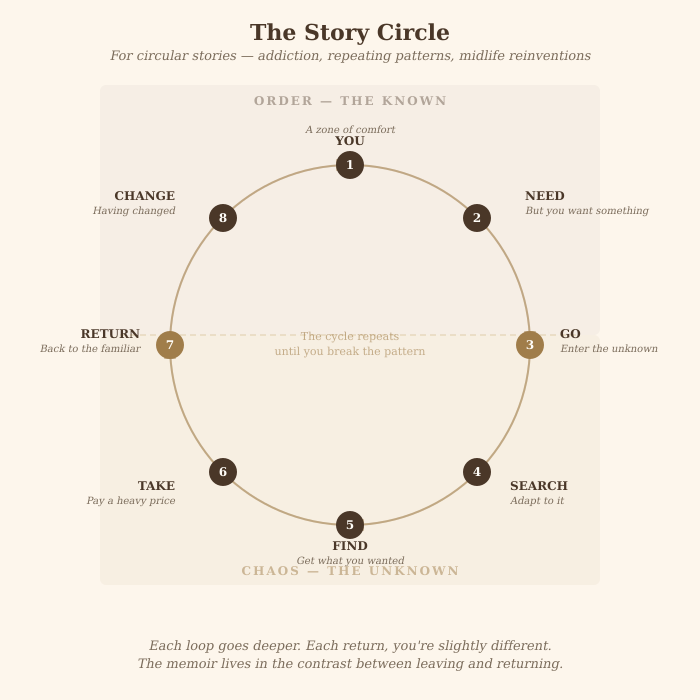
The top half of the circle is the known world. The bottom half is the unknown. Every story, Harmon argued, is about crossing from one into the other and coming back.
He called these circles "embryos" — each one containing every element a satisfying story needs. He went on to use them to structure every episode of Community and Rick and Morty, mapping even the smallest subplot as a complete circle. "I can't not see that circle," he told Wired magazine. "It's tattooed on my brain."
But Harmon didn't invent the circle. He excavated it. The same rhythm — order, chaos, return — runs through the Odyssey, through the Gospels, through every myth where the hero leaves home and comes back changed. And it runs through the parts of your life where you kept leaving home and coming back, too.
When to Use the Story Circle
The MemoirMaster Arc is your primary tool. Use it first. It gives your memoir direction, shape, and a clear emotional destination.
The Story Circle is a supplementary structure for specific situations:
Use it when a pattern repeated. You fought the same battle more than once — addiction, a toxic relationship, a recurring failure — and the meaning of your story lives in the repetition itself, not in any single event.
Use it when your story is defined by order and chaos. The rhythm of your experience was: stability, disruption, struggle, return. Then stability again. Then disruption again. The circle captures that oscillation in a way a straight line can't.
Use it when you want to experiment. If you've already mapped your memoir on the MemoirMaster Arc and want to try a different structural approach, the Story Circle offers creative possibilities. You could structure an entire chapter as a single circle. You could nest a circle inside one stage of your Arc — a loop within a loop. You could even build an entire memoir as a circle, starting and ending in the same place, with the reader understanding that place differently by the final page. These are advanced techniques, and they're here for writers who want to push beyond the step-by-step structure into something more experimental.
How the Circle Works in Practice
The key to using the Story Circle in memoir is stacking loops.
A single circle is one pass through the pattern: order → chaos → return. That's a scene, or a chapter. But the real power emerges when you map what happened the next time. And the time after that.
What changed between Loop 1 and Loop 2? What did you know the second time that you didn't know the first? What did the third return cost you that the first one didn't? Where did the circle finally crack open — and what came through?
The space between loops is where your transformation lives. Not in any single moment of crisis or clarity, but in the slow accumulation of everything each loop taught you. That's the spiral hidden inside the circles — the gradual upward (or downward) movement that only becomes visible when you lay the loops side by side.
Some stories end with the circle breaking. The addict gets clean. The relationship finally ends for good. The pattern gives way to something new.
And some stories end with the circle continuing — but with the narrator finally understanding it. Sometimes the most honest ending isn't I broke free. It's I see it now. I'm still in it. But I see it.
Both are powerful. Both are true.
"We shall not cease from exploration
And the end of all our exploring
Will be to arrive where we started
And know the place for the first time."
— T.S. Eliot, Four Quartets