In Chapters 8 and 9, you learned the 12 scene structures — the blueprints that shape how individual memories land on the page. But here's what the book couldn't fully teach you: these structures don't just make you a better writer. They make you a better communicator in every area of your life.
The best salespeople don't pitch — they tell stories. The person at dinner who has the whole table leaning in isn't reciting facts — they're structuring tension, timing punchlines, landing emotional beats. The friend who can deliver hard truth without making you defensive? They're wrapping honesty inside a narrative so it lands soft. The diplomat, the negotiator, the leader who inspires a room — they're all doing the same thing, whether they know it or not.
Storytelling isn't just a writing skill. It's a life skill. People who master it close deals. They build deeper friendships. They navigate difficult conversations with grace. They're more persuasive, more memorable, more trusted — because humans are wired to respond to stories in ways they don't respond to arguments, data, or logic.
Below, you'll see all 12 structures as actual memoir prose with tagged examples. But keep reading past them — because at the bottom of this page, we introduce an advanced technique called The Weave that separates good storytellers from great ones. It's too advanced to fully unpack in a book, but we'll give you the foundation here. The rest — the real practice, the live feedback, the instinct-building — is what our Storytelling Mastery course is designed for.
Now, the 12 structures. The tags show exactly where each structural element begins — so you can see the skeleton beneath the skin.
How to use this resource:
- Find the structure that matches your scene. Ask yourself: what kind of memory is this? Funny? Tense? Transformative? Match the feeling to the structure.
- Read the example through once for the story. Don't analyze yet — just let it land.
- Read it again watching the tags. Notice how each section earns the next one.
- Write your own scene using the same skeleton. Replace the content with your memory. Keep the structure. The tags are your scaffolding — you can remove them when you're done.
You don't need to memorize these. You need to recognize them. Over time, matching scene to structure becomes instinct.
1. Basic Structure
Situation We moved on a Tuesday. The truck was already packed — my mother had done it herself while my father was at work, filling boxes in the order she planned to unpack them. Kitchen first, then bedrooms, then everything else. She was methodical about leaving.
Action I carried the last box down the stairs — the one with the phone books and junk drawer contents that nobody would ever open again — and set it on the tailgate. My mother locked the front door, slid the key under the mat, and got into the truck without looking back. I stood there for a second, waiting for something to feel different. It didn't. It just felt like a Tuesday.
Consequence We drove to the new apartment in silence. She played the radio low. I watched the neighborhoods change outside the window — the houses got smaller, the lawns got shorter, and by the time we pulled into the parking lot, I understood that we were starting over whether I was ready for it or not.
Bridge It took three days to unpack everything. The kitchen first, then the bedrooms, just like she'd planned. By Thursday, the new place looked like we'd always lived there. And in a way, we had. We were the same people. Just in a different building with thinner walls.
2. Comedy Structure
Setup My grandmother had one rule about her house: no shoes on the white carpet. She'd had that carpet installed in 1974 and it was still pristine, a monument to her vigilance. We all complied. Shoes came off at the door, every time.
Build So when my Uncle Ray showed up to Christmas dinner drunk, tracking mud from his truck, we knew it was about to get ugly. Grandma stood at the edge of her white carpet like a general defending a border. "Raymond. Shoes." He looked down at his boots, looked at her, and said, "I'm not staying long."
Punchline Then he took three steps onto that white carpet, left a perfect muddy boot print, turned around, and walked back out. We didn't see him for two years.
Tag Grandma cleaned the carpet herself. By hand. In silence. It took her an hour. The stain never fully came out, and every Christmas after that, we'd stare at that spot and nobody would say a word.
3. Dramatic Tension Structure
Stakes The doctor called on a Tuesday and asked if I could come in to discuss my test results. "It's better if we talk in person," she said. I knew what that meant. Good news comes over the phone.
Uncertainty I had three days before the appointment. I didn't tell my wife. I couldn't. If I said it out loud, it would become real. I moved through those days like a ghost, watching her make dinner, watching her laugh at something on TV, thinking: How many more nights do we have?
Delay The waiting room was full. I sat there for forty minutes past my appointment time, watching other people walk in and out. A woman my age, crying. An older man, stone-faced. I tried to read their futures in their faces.
Reveal When the doctor finally called me back, she was smiling. "False alarm," she said. "The lab mixed up your sample with someone else's. You're fine." I stared at her. She was still talking — something about protocols, apologies — but I couldn't hear her over the roar in my head.
Aftermath I walked out of that office and sat in my car for an hour. I didn't feel relief. I felt rage. Three days I'd lived like a dying man. Three days I'd said silent goodbyes. And none of it was real. I went home and told my wife everything. She cried. I didn't.
4. Romance/Connection Structure
Meeting I met her at a bus stop in the rain. She was reading a book I'd loved, holding it like a shield against the weather. I said, "That book broke me." She looked up, rain dripping off her hood, and said, "Good. You needed breaking."
Connection We missed our bus. Then the next one. We stood under the shelter and talked until the rain stopped and the evening turned cold. She told me about her brother's death, and I told her about my divorce, and neither of us pretended to have answers. It was the most honest conversation I'd had in years.
Obstacle When I asked for her number, she hesitated. "I'm leaving in two months," she said. "Moving to Seattle. I'm not looking to start something I can't finish." I nodded. I understood. But I asked anyway.
Choice She gave me her number. I called the next day. We had eight weeks. We both knew it. But we chose to pretend we had forever.
Bond She left in November. We tried long distance for a while, but it didn't work. We stopped calling. But sometimes, years later, I still think about that bus stop. She was right — I needed breaking. And she was kind enough to do it gently.
5. Epiphany Structure
Fog I spent years wondering why I couldn't keep a relationship. I told myself I picked the wrong people, that I had bad luck, that I was just too independent. I had a dozen explanations. None of them true.
Catalyst Then one night, my best friend got drunk and told me the truth. "You don't let anyone in," she said. "You act like you do, but you don't. You're always halfway out the door." I got angry. Defensive. But when I got home, I couldn't stop thinking about it.
Aha! The realization hit me in the shower two days later, out of nowhere. I didn't leave because they weren't right for me. I left before they could leave me. Every single time. My father left when I was six. I was still running from that.
Shift I called my therapist that morning. We'd spent months talking around this. Now we could finally talk about it. I wasn't broken. I was protecting a six-year-old who didn't understand why his dad never came back.
Proof It didn't fix me overnight. But the next time I felt the urge to bolt from a relationship, I recognized it. I stayed. It was terrifying. And it was the beginning of something real.
6. Suspense Structure
Question My mother started hiding money in strange places. I found a twenty-dollar bill folded inside a tampon box. A fifty tucked into the spine of a Bible. She wouldn't say why.
Clues Then I noticed other things. She started locking her bedroom door. She stopped answering the phone. She asked me, casually, how much a bus ticket to New Mexico cost. I said I didn't know. I didn't ask why she wanted to know.
False Answers I thought maybe she was having an affair. Or planning to leave my father. Or saving up for something she didn't want him to know about. I made up stories in my head, trying to solve the puzzle.
Dread One night I woke up to her crying in the kitchen. I stood in the hallway, listening, too afraid to go in. She wasn't crying like someone who was sad. She was crying like someone who was afraid.
Truth A week later, my father went to jail. Embezzlement. She'd known for months. The money she was hiding — that was her escape fund. The locked door, the bus ticket, the fear — she was preparing to run. She never had to. He got ten years. She stayed in the house. The hidden money stayed hidden. I never asked her why she didn't leave. I think I already knew.
7. Loss/Grief Structure
Last Normal The last normal day was a Saturday. My daughter was seven. We made pancakes shaped like dinosaurs. She insisted on pouring the syrup herself and drowned them until the plate was a sticky lake. I took a picture. I didn't know I'd look at that picture ten thousand times.
Blow The call came Sunday morning. The driver didn't see the red light. My ex-wife was killed instantly. My daughter was in the ICU. I drove to the hospital like a man in a dream, convinced I'd wake up before I got there.
Numbness The first week, I felt nothing. I signed papers. I made arrangements. I sat by my daughter's bed and held her hand while machines beeped. People said I was strong. I wasn't strong. I was a building after an explosion — still standing, but gutted.
Waves The grief came later, in ambush. I'd be folding laundry and suddenly I couldn't breathe. I'd see a woman in the grocery store with the same haircut and have to leave my cart in the aisle. The waves came without warning and knocked me flat every time.
New Absence My daughter recovered. We moved to a new apartment, started a new school. We built a new life. But there's a chair at our table that stays empty. I still set three plates sometimes, out of habit. Then I put one back. Every single time, it hurts. I think it always will.
8. Adventure Structure
Mission We were going to drive from New York to San Francisco in four days. My best friend had a job interview, I had nothing better to do, and we had his brother's Ford Taurus and $300 between us. It was a terrible plan. We left on a Tuesday.
Obstacles The Taurus broke down in Pennsylvania. We fixed it with duct tape and prayer. We ran out of money in Indiana and sold our CDs to a pawn shop. In Nebraska, we got pulled over for speeding and talked our way out of a ticket by pretending we were driving to a funeral. "Whose funeral?" the cop asked. We said "Grandma" at the same time. He let us go.
Escalation By Wyoming, we'd been awake for 30 hours straight, fueled by gas station coffee and sheer stupidity. We were hallucinating exits that didn't exist. My friend kept insisting he saw a moose in a diner parking lot. "That's a dumpster," I said. "No," he said. "It winked at me."
Peak We made it to San Francisco on day five, twelve hours late. The Taurus died in the parking lot of the building where the interview was. Just rolled to a stop and gave up. My friend got out, looked at the car, looked at me, and started laughing. We both did. We laughed until we cried.
Landing He didn't get the job. We sold the Taurus for scrap and took the bus back to New York. But for the rest of our lives, whenever things got hard, one of us would say, "Remember the moose?" And we'd know we could survive anything.
9. Shame/Confession Structure
Context I was twenty-two, broke, and desperate. My rent was two months overdue. My car had been repossessed. I was three weeks from being homeless, and I'd exhausted every legitimate option. That's when my roommate told me about the job.
Choice It was a telemarketing scam targeting the elderly. We called seniors and sold them magazine subscriptions they didn't want, couldn't afford, and would never receive. I knew it was wrong. I took the job anyway. I told myself I'd quit as soon as I got back on my feet.
Consequence I worked there for six months. I got good at it. I learned to sound trustworthy, to mirror their loneliness, to close the sale before they had time to think. I made an old woman cry once. She said she couldn't afford it, but I pushed until she gave me her credit card. I hit my quota that day.
Reckoning I quit the day I called a man who sounded exactly like my grandfather. Same cadence, same pauses, same hopefulness in his voice. I couldn't do it. I hung up mid-script. I walked out and never went back. But I'd already done the damage. To dozens of people. Maybe hundreds.
Redemption I can't undo what I did. I tried to find some of the people I scammed, but I had no records. All I could do was promise myself I'd never rationalize cruelty again, no matter how desperate I was. It's a promise I've kept. But I still think about that woman I made cry. I always will.
10. Montage Structure
Rhythm Every Sunday, my father cooked breakfast. Eggs, bacon, toast. The same meal, the same time, for twenty years. It was the one constant in our house.
Repetition He'd wake up at 7 AM. Put on the same apron. Crack the eggs the same way — one-handed, into the same yellow bowl. He never spoke while he cooked. The kitchen was his church.
Variation Some Sundays, we were all there — Mom, me, my sister. We'd sit around the table and pretend we were a normal family. Other Sundays, it was just me and him, eating in silence while Mom slept off whatever had happened the night before. And some Sundays, after I moved out, I knew he was cooking breakfast alone.
Break The Sunday after Mom left him, I drove to his house. I let myself in with my key. He was standing at the stove, same apron, but the eggs were burning. The smoke alarm was going off. He didn't seem to notice.
Meaning I turned off the stove. We sat at the table with no food. And for the first time in my life, I understood that those Sunday breakfasts weren't about the eggs. They were about structure. About holding on to one small thing when everything else was chaos. When he stopped cooking, I knew he'd given up.
11. Dialogue Structure
Tension We hadn't spoken in three days. My wife and I were living like roommates who hated each other, moving through the house in careful silence. I knew we couldn't keep going like this. One of us had to say something.
Opener She finally broke on Thursday night. We were both in the kitchen, avoiding eye contact, when she said, "I can't do this anymore."
"Do what?" I asked, though I knew.
"This. Us. Pretending."
Escalation "I'm not pretending," I said.
"Yes, you are. You've been pretending for two years. You think I don't see it? You think I don't feel it?"
"Feel what?"
"That you don't want to be here. That you're staying out of guilt, not love."
"That's not true."
"Then look at me and tell me you're happy."
The Line I opened my mouth to lie. To say the words that would smooth this over, buy us another year of slow suffocation. But I couldn't. Instead, I said, "I don't know how to be happy anymore."
Silence She nodded. She didn't look surprised. She looked relieved. We stood there in the kitchen, the truth finally between us, and neither of us said another word. We didn't have to. The marriage ended in that silence.
12. Persuasion Structure
Resistance My mother didn't want to go to the doctor. She'd had the cough for three months, but she insisted it was nothing. "I'm fine," she said. "Stop fussing." I'd heard her say that my entire life. It had always meant the opposite.
Evidence I showed her the facts. "You can't sleep lying down anymore. You've lost fifteen pounds. You're coughing up blood." She waved me off. "It's just a cold." I showed her the tissue she'd thrown away that morning, rust-colored with blood. "That's not a cold."
Objection "I don't want to know," she said finally. And there it was — the real reason. "If it's bad, I don't want to know. I'd rather just... let it happen."
"You don't mean that."
"I do. I'm seventy-four years old. I'm tired."
Reframe I sat down next to her. "Okay," I said. "But if you don't go, I'll spend the rest of your life wondering if I could have saved you. And you'll spend it knowing you chose to leave me that way. Is that what you want?"
Shift She looked at me for a long time. Then she picked up her purse. "Fine," she said. "But if they find something, I'm blaming you." It was pneumonia. Treatable. She lived another eight years. And every time she got annoyed with me, she'd say, "This is your fault. I could be dead right now." I'd smile. "You're welcome."
The Scene-Writing Algorithm
When you sit down to write a scene, ask yourself these four questions in order:
- What Act am I in? (Act I, Act II, or Act III from your 3-Act Structure)
- What MemoirMaster Arc stage is this scene in? (Which of the 10 outer stages?)
- What Inner Journey stage am I at here? (The corresponding inner stage)
- What does this scene need to do emotionally? (Make the reader laugh / feel dread / witness a realization / etc.)
The answer to question 4 tells you which of these 12 structures to use. Now you have your skeleton. Write the scene.
The Weave: Stories Within Stories
You already know how to use each of the 12 structures on its own. Now here's the technique we promised at the top — the one that separates good storytellers from great ones: nesting one structure inside another.
Think about how people actually tell stories in conversation. Nobody speaks in clean, isolated structures. They start telling you about their morning, and halfway through, something reminds them of a completely different story, so they take a detour — tell that story — and then come back to finish the first one. You've done this a thousand times without thinking about it.
That's a weave. The outer story is the shell. The inner story is the detour. And the whole thing works beautifully — as long as you close both loops.
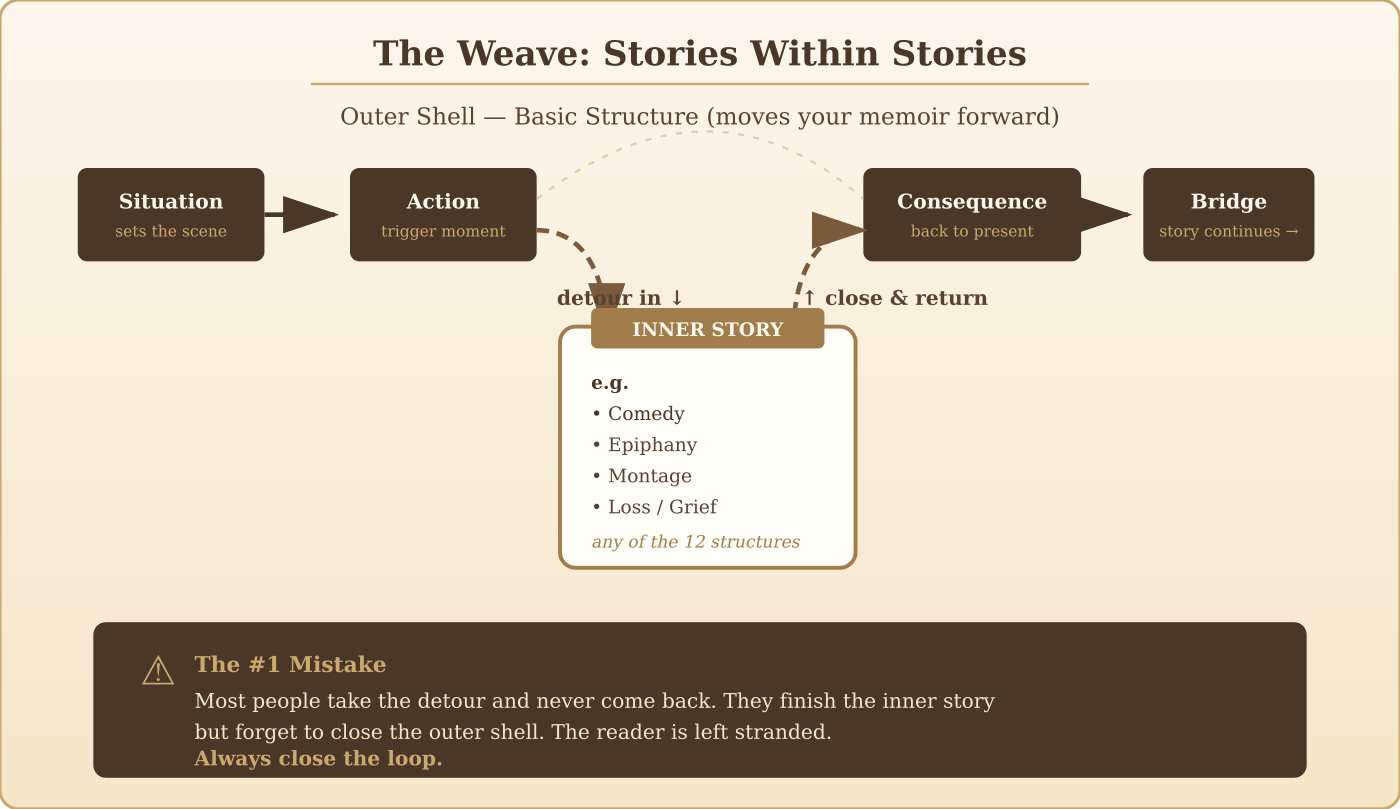
The #1 Mistake: Leaving the Outer Shell Open
Here's the problem. Most people — even naturally gifted storytellers — take the detour and never come back. They finish the inner story, get the laugh or the reaction, and move on to something else entirely. The outer story just... evaporates. The listener is left with a nagging feeling that something was left unfinished, even if they can't name it.
You've experienced this. Someone starts telling you about something that happened at the grocery store, then veers into a story about their college roommate, then finishes the college story and says, "Anyway, what were we talking about?" You were at the grocery store. You never found out what happened.
In conversation, this is a minor annoyance. In memoir, it's a structural crack. Your reader notices, even subconsciously. The fix is simple: always close the outer shell. Finish the detour, come back to where you left off, and land the original scene. Two complete structures. One seamless passage.
The Basic Structure Is Your Best Outer Shell
The Basic structure — Situation → Action → Consequence → Bridge — is the natural home for weaving. It's your workhorse. It handles the transitional, everyday moments that move your memoir forward: driving somewhere, unpacking boxes, waiting in line, walking to the store. Nothing dramatic. Just life happening.
That simplicity is exactly what makes it the perfect outer shell. The Basic structure creates forward motion. The inner story creates emotional depth. Together, they do more than either could alone.
Here's what a weave looks like:
Example: Basic Shell + Comedy Weave
Situation I was stuck in traffic on the interstate, forty minutes from my daughter's school play. The dashboard clock said 6:22. Curtain was at 7:00. I was not going to make it.
Action I changed lanes, got behind a minivan with a bumper sticker that said "My Kid Is an Honor Student at Jefferson Elementary." That was my daughter's school. I stared at that bumper sticker for three lights, inching forward, and started thinking about the last school event I'd almost missed — her science fair, two years earlier.
Setup She'd built a volcano. Every kid builds a volcano. But my daughter had decided hers would be different. She'd seen a YouTube video about adding dish soap to the baking soda mix to create "lava foam," and she'd scaled up the recipe by a factor of ten because — and I quote — "bigger is always better, Dad."
Build I arrived at the gymnasium just in time to see her standing behind her volcano with the confidence of a woman about to launch a rocket. The judges were approaching. She made eye contact with me across the room and gave me a thumbs up. Then she poured in the vinegar.
Punchline The foam didn't just overflow. It erupted. A cascade of orange foam shot three feet in the air, splattered across the table, soaked the judge's clipboard, and dripped onto the project next to hers — a kid's carefully arranged butterfly collection, now buried under what looked like radioactive lava. My daughter stood there, covered in foam, grinning like she'd just discovered plutonium.
Tag She got third place. The butterfly kid got a do-over. And for the next year, every time I picked her up from school, some parent would say, "Oh — you're the volcano dad." I wore that title with pride.
Consequence I was still smiling about the volcano when I realized traffic had broken. I looked at the clock: 6:41. I pressed the gas and made it to the school parking lot at 6:56. Four minutes to spare.
Bridge I found a seat in the third row just as the lights went down. When my daughter walked onstage, she spotted me and did the same thumbs up she'd given me before the volcano. I gave her one back. I made it. This time, nothing exploded.
Montage as Backstory Weave
The Montage structure is especially powerful for weaving because it exists outside your main timeline. Your memoir moves forward chronologically, but some of the most important context — where a belief came from, why you are the way you are, what shaped a relationship over decades — lives in the past. You can't stop your story to write a five-page backstory chapter. But you can weave a montage into a scene that's moving forward.
Imagine you're writing a scene where you distrust someone new. The reader needs to understand why — but the reason is a pattern from childhood, not a single event. A montage weaved into the present scene can show that pattern in a paragraph or two: the rhythm of your mother's broken promises, the repetition, the variation, the one time it broke. Then you're back in the present, and the reader understands your distrust without you ever having to explain it.
Harder Weaves: Mixing Opposite Emotions
Some combinations are natural. A Basic shell with a Comedy weave works intuitively — your mind was wandering, something funny came to mind, you smiled. An Adventure shell with an Epiphany nested inside — you were on the road when you suddenly realized something. These feel effortless.
Other combinations are harder because the emotions pull in opposite directions. Weaving comedy into a Grief structure feels wrong at first. But think about a eulogy. The best eulogies do exactly this — they sit inside the deepest sadness and find the moments that make everyone laugh through their tears. The comedy doesn't undercut the grief. It proves how well you knew the person. How alive they were. How much there is to miss.
The rule isn't "don't mix opposites." The rule is: know what you're doing. A comedy detour inside a grief scene is powerful when it's intentional. It's a disaster when it's accidental — when you stumble into humor because you're uncomfortable with sadness, and the reader can feel you flinching.
When It Becomes Second Nature
Here's the thing about weaving: once you see it, you can't unsee it. Every great storyteller you've ever listened to does this. Every memoir you've ever loved does this. They take detours. They tell stories inside stories. They leave one thread hanging for just long enough to pull you into another, then they come back and tie them both off.
Right now, this feels like a technique — something you have to think about consciously, plan deliberately. That's fine. That's how all skills start. You learn the structure. You practice it intentionally. You stumble. You get better.
But eventually, something shifts. You start telling a story to a friend and you notice yourself taking a detour — and closing it. You notice yourself nesting a funny aside inside a serious point, and landing both. You watch someone else tell a story and you can see the structures they're using, even though they've never heard of any of this. You start noticing when someone takes a detour and forgets to come back, and you think: they didn't close the outer shell.
That's when the software is installed. You stop thinking about the technique and start just doing it. The structures become invisible — not because you forgot them, but because they became part of how you think. How you see. How you tell.
That's mastery. And it doesn't come from reading about it. It comes from doing it — over and over, with real stories, watching real reactions, adjusting in real time. Every time you tell a story and someone leans in, you learn something no book can teach you. Every time someone's eyes glaze over, you learn even more.
This Is a Preview
The weaving technique is part of Storytelling Mastery — the course that takes you beyond the book into advanced storytelling craft. In the course, we go deeper: multi-layer weaves, emotional contrast mapping, how to practice with live audiences, and how to develop the instinct that makes all of this automatic.
The book gives you the 12 structures. The course teaches you to play them like instruments — individually, together, and in combinations you haven't imagined yet.
Structure is invisible to the reader — but it holds everything together. Now you've seen the bones. Go write the flesh.