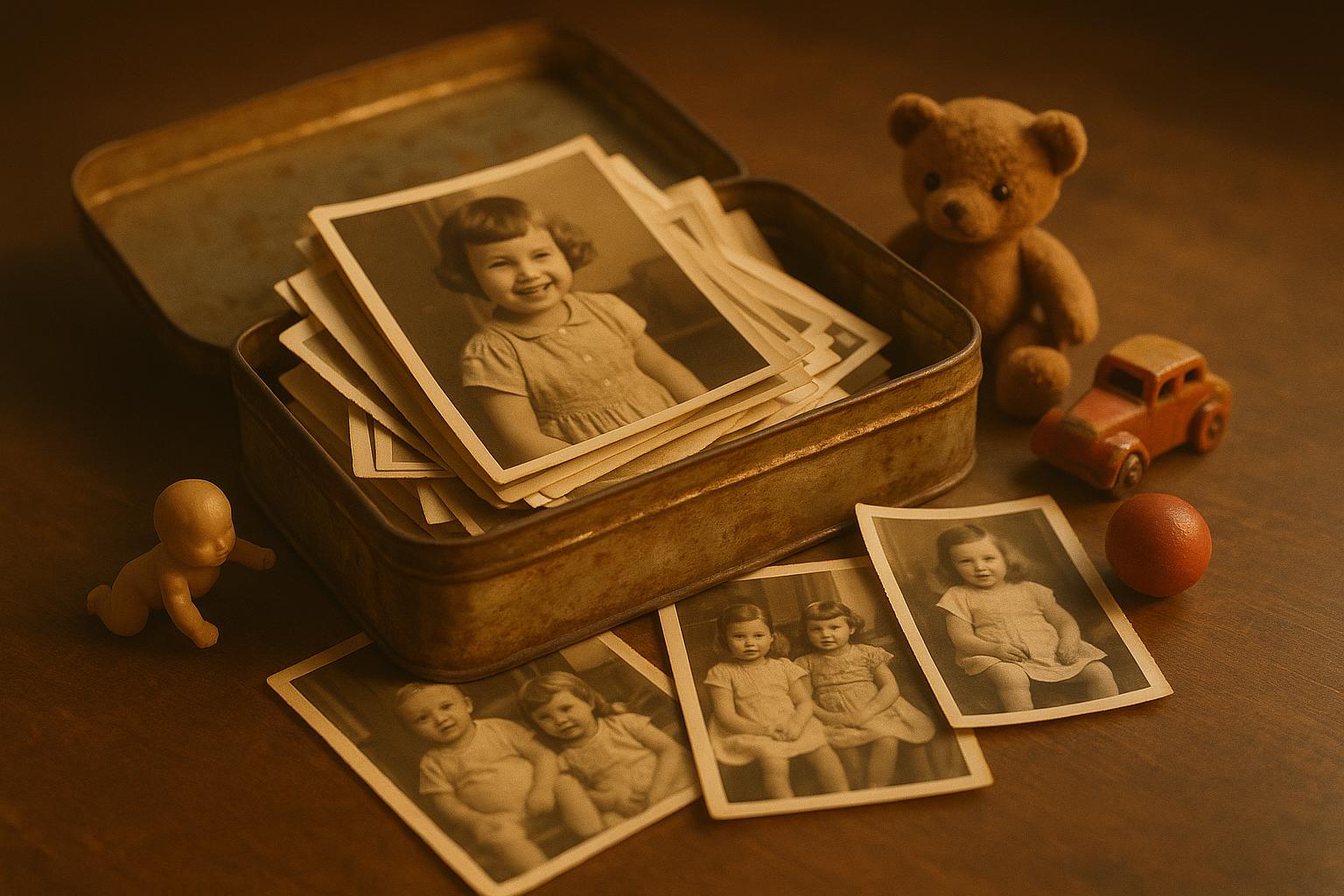
Writing about your childhood in a memoir doesn't require perfect recall — and it doesn't require you to have had a perfect childhood. What it requires is the willingness to render honest scenes from a child's-eye view, with all the confusion, wonder, and incompleteness that comes with it. That's not a limitation. That's the material.
Childhood chapters are often the most powerful in any memoir, precisely because the writer is working with incomplete information and adult hindsight at the same time. Done right, that gap — between what the child understood and what the adult now knows — is what creates emotional depth.
Here's how to write about your childhood without getting stuck on what you can't remember, and without flattening it into a flat summary of events.
In This Post
- Write from the child's perspective, not the adult's
- How to handle gaps in memory honestly
- Which childhood scenes belong in your memoir?
- Use sensory detail to rebuild the world
- Writing about family: the childhood challenge
- How to use adult hindsight without ruining the scene
- Reconstructing childhood dialogue
- How to actually start writing
Why Does Writing from the Child's Perspective Matter?
Here's the most common mistake people make when writing childhood scenes: they write them from the adult's point of view.
They explain what was really happening. They tell you what their parents were going through. They contextualize the divorce, or the poverty, or the dysfunction, with knowledge they didn't actually have at age eight.
The result reads like a case study, not a memory. It's informative. It's not alive.
The most powerful childhood scenes in memoir are the ones that trust the child's perception — even when it's wrong, even when it's confused, even when the child is the last one to understand what's happening in the room.
This isn't just a craft technique. It's honest. You were that child who didn't understand. That confusion is part of your story.
How Do You Handle Gaps in Childhood Memory?
Everyone who writes about childhood eventually hits the same wall: I can't remember exactly what was said. I'm not sure which year this happened. My siblings remember it differently.
This is not a problem. This is memoir.
Memoir has never demanded journalistic accuracy. It demands emotional truth — the honest rendering of your experience and your understanding at the time. The details you fill in around a core memory aren't fabrications; they're the texture of a world you actually lived in.
If you remember the kitchen but not exactly which chairs were at the table, describe the kitchen you remember. That kitchen was real. If you remember the argument but not the exact words, write the words that fit the argument you remember having. The emotional content is what matters.
What you cannot do is invent events that didn't happen, or misrepresent real people's actions in ways that are materially false. That's where memoir crosses into fiction. But rendering a scene with reconstructed dialogue, approximate timelines, and composite detail? That's standard memoir practice. Mary Karr does it. Frank McCourt did it. Every memoirist does it.
"I remember the feeling perfectly. The details I've filled in around it — those are just what that feeling lived inside of."
When you're genuinely uncertain, you can signal it on the page: "I think I was seven." "As best I remember it." "I've been told this is how it happened, though my memory starts a few minutes later." This kind of honesty doesn't weaken the memoir. It deepens the reader's trust.
Which Childhood Scenes Actually Belong in Your Memoir?
Not every childhood memory belongs in a memoir. This is where a lot of writers get lost — they have decades of material and no filter for what matters.
The filter isn't "what was important in my life." The filter is: what serves the transformation this memoir is tracking?
Your memoir has a theme — a central question, a change, an arc. The childhood scenes that belong are the ones that either establish who you were before the central transformation began, or that contain early seeds of the conflict that will drive the story forward.
If your memoir is about learning to trust again after betrayal, the childhood scene of your father breaking a promise belongs. The childhood scene of your first bicycle probably doesn't — unless the bicycle connects directly to the theme of trust and betrayal.
This is how published memoirists choose. Not sentiment. Not chronology. Theme.
A good starting question: What did I believe about the world at the start of this story, and when did I first learn it? That's likely a childhood scene worth writing. The three questions in this post on unlocking any memory can help you find it.
How Do You Use Sensory Detail to Rebuild a Childhood World?
Childhood has a sensory texture unlike any other period of life. Everything is bigger. Smells are more intense. Sounds carry more weight. Time moves differently.
That texture is your access point to scenes your explicit memory has partially lost.
Start with what you can remember physically: the smell of your grandmother's house, the sound of a screen door, the specific weight of a backpack, the quality of light in a particular room at a particular time of year. Anchor the scene in that sensory reality and the rest often follows.
This isn't decorative writing. Sensory detail is how you put the reader in the scene with you. It's the difference between "we ate dinner together every night" and the specific memory of the linoleum floor, the hum of the refrigerator, the way your father set his fork down before he said something difficult.
One scene rendered this way is worth ten paragraphs of summary. Always.
How Do You Write About Family Members from Childhood?
This is where memoir writers most often freeze up. Parents. Siblings. Grandparents. People who are still alive, or who were complicated, or who saw things differently than you did.
The first thing to understand: your memoir is your account of your experience. It's not a verdict on anyone else. You're not writing a biography of your mother. You're writing about who she was to you, in the scenes that matter to your story.
That distinction does a lot of work. You can write honestly about a difficult parent without rendering a trial verdict. You can show behavior that hurt you without claiming to know every motivation behind it. The child you were didn't know those motivations. Write from that perspective and you're already being more honest than most people manage.
The guidance in this post on writing about people you love is essential reading here — especially for parents and siblings who complicated your childhood in ways you're still sorting out.
A practical rule: show behavior, not character assassination. "He came home angry and didn't speak to us for three days" is a scene. "He was a narcissist who never cared about anyone but himself" is a verdict. The scene is more powerful and more defensible. The verdict closes the reader out.
Ready to Write Your Memoir?
MemoirMaster: How To Write A Memoir gives you the complete system for turning your memories — including the complicated ones — into a story worth reading. Structure, scenes, voice, and arc: everything you need to go from scattered notes to a finished manuscript.
Get the Book →How Do You Use Adult Hindsight Without Ruining the Scene?
One of the most powerful tools in childhood memoir is the contrast between what the child understood and what the adult now knows. Used well, this creates layers. Used clumsily, it kills the scene.
The rule: don't explain the scene while you're in it.
Stay inside the child's experience for the duration of the scene. Don't interrupt to tell the reader what was "really" happening, or what you now know your mother was going through, or how therapy later helped you understand the dynamic. Stay in the child's body, the child's confusion, the child's partial understanding.
Then, in the white space after the scene — a paragraph of reflection, a brief transition — you can step back as the adult narrator. One or two sentences. "I didn't understand then that she was terrified." That's enough. Let the contrast do the work.
The reader will feel the gap between those two perspectives. That gap is where emotional resonance lives. You don't have to explain it. Just create it.
How Do You Write Dialogue from Childhood Scenes?
Nobody remembers the exact words. That's fine. Reconstructed dialogue in memoir isn't fabrication — it's your best honest rendering of what was said, in the voice of the people involved.
The test is this: does this dialogue represent the emotional truth of the conversation? Not a transcript — the truth. The argument you had with your father sounded like something. Your mother's voice in a particular moment had a specific quality. Your job is to render that, not quote it.
Write dialogue that fits the people, the relationship, and the emotional content of the moment. If you genuinely don't remember anything about what was said — only what happened — you can keep the scene in summary: "We argued about it for most of the drive home." That's honest. It doesn't require invented words.
For a deeper look at how to write dialogue in memoir generally — including how to handle composite conversations and reconstructed exchanges — this post on memoir dialogue covers the full technique.
How Do You Actually Start Writing a Childhood Scene?
Most people overthink the opening. They try to start at "the beginning" — birth, early years, some establishing context — and immediately run into the problem that the beginning isn't interesting yet. The reader hasn't been given a reason to care.
Don't start at the beginning. Start at a scene.
Pick a specific moment — one afternoon, one dinner table argument, one morning before school — and start there, in the middle of the action. "The summer I was nine, my father came home with the news that we were moving." You're already in a story.
From there, you can build in context as the reader needs it. But the scene comes first. Always the scene.
The urge to provide context before the scene is a stalling mechanism. The reader doesn't need the context yet. They need to be somewhere, with someone, in a moment that's already moving. Context comes after trust is established. Trust comes from scenes.
The Short Version
Writing about your childhood in a memoir comes down to a few things:
- Write the scenes from inside the child's experience, not the adult's explanation
- Fill in sensory detail around what you actually remember — that texture is accurate even when exact words aren't
- Choose scenes based on theme, not chronology or sentiment
- Write family members honestly without rendering verdicts on their character
- Use the gap between child understanding and adult knowledge — that contrast is where the emotional power lives
Your childhood is not too ordinary to write about. It's not too complicated, too painful, or too far away to render clearly. What it needs is the right frame — and then the willingness to sit down and actually be in those scenes again.
That's the work. It's worth doing.
Want to work through this with a group? We're launching live memoir writing workshops soon — get on the list.
Your Childhood Story Is Worth Telling
The MemoirMaster system gives you the structure to write it well — from finding your theme, to building scenes, to getting from first draft to finished manuscript. If you're serious about writing your story, this is where you start.
Get the Book →