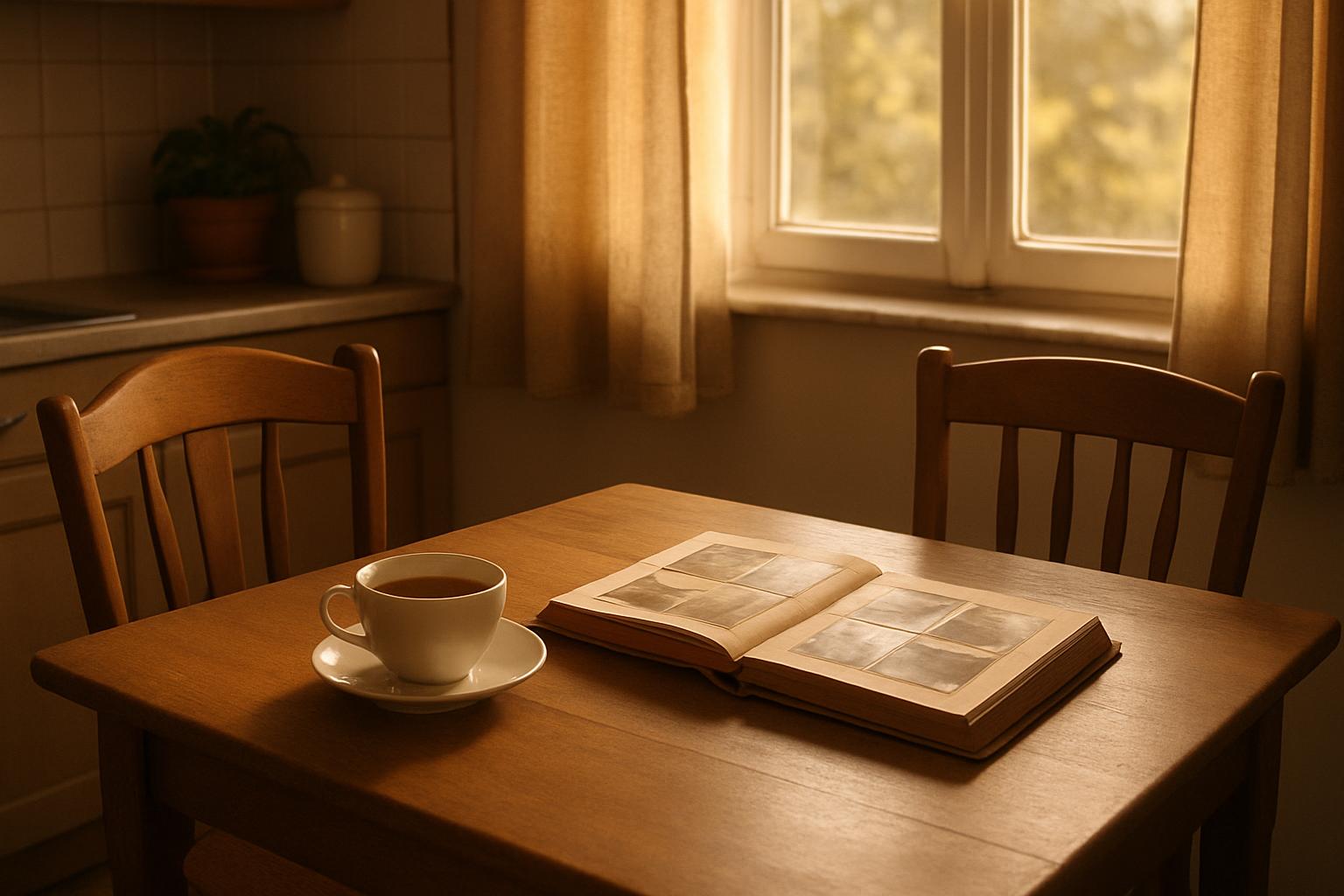
Writing a family history book starts with one decision: choosing whose story to center. Not every family member, not every generation — one thread. Once you have that, everything else follows. The book takes shape. The interviews make sense. The photos find their place.
Most people who want to write a family history book never start because they think it has to be everything. It doesn't. A focused family history — one life, one generation, one branch of the tree — is more powerful and far more readable than an exhaustive genealogical record. And it's actually achievable.
Here's how to do it.
Table of Contents
What Is a Family History Book, Exactly?
A family history book is a written record of your family's stories, people, and experiences — shaped into something readable rather than just a list of names and dates. It lives somewhere between genealogy (who came from whom) and memoir (what it felt like to live through it).
The best family history books are story-driven. They don't just document facts; they capture personality. They make your great-grandmother feel like a real person — not a name on a family tree with birth and death dates bracketed around it.
Think of it this way: a family history book is what you hand your grandchildren when you want them to understand not just where they came from, but who came before them.
How Do You Choose What to Focus On?
This is the decision most people avoid, and it's the one that determines whether the project ever gets finished.
You have options:
- One person's life story — a parent, grandparent, or ancestor whose life is compelling enough to carry a full narrative. This is the most readable approach.
- One generation — the story of your grandparents' generation, covering several siblings or cousins and the world they lived through together.
- One branch of the family tree — following your maternal or paternal line across several generations, with a chapter or section per generation.
- One defining era — the family's experience of a specific time period: the Depression, WWII, immigration, a particular city or country.
The question to ask yourself: What story do I most want to make sure gets told?
Start there. You can always expand later. You cannot finish a book that has no defined scope.
If you're writing about a parent or grandparent still living, read How to Write a Memoir About Your Parents (Before It's Too Late) — it covers the specific challenge of capturing someone else's life while they can still contribute to it.
How Do You Gather the Stories?
This is the part people find most intimidating. It's also the most rewarding part — because this is where you discover things you never knew.
Start with interviews
If the people you're writing about are still living, interview them. Record the conversations (with permission). Ask open-ended questions, not yes/no ones. "What was the hardest year of your life?" gets you a story. "Did you have a hard time growing up?" gets you a one-word answer.
1. What do you remember most vividly about that time?
2. What were you most afraid of — and what happened?
3. What do you wish you'd understood sooner?
These questions work on 80-year-olds and 50-year-olds alike. They bypass the surface and get to the story underneath.
Don't just interview the person at the center of the book. Interview siblings, children, old friends — anyone who was there. Memory is collaborative. What one person forgets, another remembers. What one person sees one way, another saw differently. That friction is part of the story.
For a deeper framework on interview questions, see The 3 Questions That Unlock Any Memory.
Mine the documents
Old letters, diaries, immigration papers, military records, newspaper clippings, tax records, church documents — all of this is raw material. These aren't just supporting evidence; they're windows. A letter someone wrote in 1944 doesn't just tell you what happened. It tells you how they thought, what they cared about, how they used language.
Ask every family member if they have boxes. There are almost always boxes. Attics, closets, storage units — families hold onto more than they realize.
Use public records
Ancestry.com, FamilySearch.org, and the National Archives are treasure troves. Census records tell you who was living in what house. Ship manifests tell you exactly which boat someone arrived on and what they listed as their occupation. Military records show when someone enlisted, where they served, and sometimes what happened to them.
This isn't just genealogical data. It's detail that makes a scene come alive: He arrived at Ellis Island on a Tuesday in February, with $11 in his pocket and no English. That came from a record. But now it's a story.
How Do You Organize a Family History Book?
Most family history books use one of three structures:
Chronological — start at the beginning, move through time. Simple and intuitive. Works well for a single life story or a clear immigration narrative. The risk is that early chapters can feel slow before the "interesting" period begins. Fix this by starting in the middle of something — then flashing back.
Thematic — organize by topic rather than time. One chapter on family values and traditions. One on the hardships they faced. One on the relationships that defined them. One on what they built. This works well when the person's life doesn't follow a dramatic arc but contains rich material in every direction.
Generational — a chapter or section per generation, moving forward through time. Works well for multi-generational family histories. The challenge is making each section feel cohesive rather than just a parade of names.
My recommendation: start chronological and let it breathe. Chronological organization is the easiest to read and the easiest to write. You can always restructure later. What you cannot do is restructure something you haven't written.
Ready to Write Your Family's Story?
The MemoirMaster book gives you the complete system — from choosing your focus to writing your final chapter. It's built for people who've never written a book before and have a story that needs to be told.
Get the Book →How Do You Actually Write It?
Here's the part most guides skip: the actual writing is easier than you think, because family history books don't require you to invent anything. Every story you're telling actually happened. You're not creating — you're reconstructing and shaping.
That said, a few principles make the writing significantly better:
Write scenes, not summaries
There's a difference between telling and showing. "He worked hard his whole life" is a summary. "He was at his desk by 5 a.m. every day, even on Christmas Eve, even the winter his father died" is a scene — or the beginning of one. The second one makes you feel something. The first one doesn't.
Whenever you have a specific memory, a specific moment, a specific detail — write it as a scene. Put the reader there. Let them see what you see. That's what makes a family history book something people actually read instead of file away.
Use the documents and interviews as your script
You're not making this up. The letters tell you what someone said. The interviews tell you what they remember. The records tell you what happened. Your job is to take all of that raw material and arrange it into a story with a shape — a beginning, a middle, an end, and a reason for existing.
Write in your own voice
The narrator of a family history book doesn't have to be invisible. Some of the best family histories include the author's own perspective — their surprise at what they discovered, their grief at what was lost, their gratitude for what was preserved. You don't have to be a ghost. You can be present in the story as the person who went looking for it.
This is especially true if you're blending family history with personal memoir — which many writers end up doing, because the search for family history often becomes its own story.
Don't wait for perfect
First drafts of family history books are always messy. You have too much material, not enough of it, gaps where you need more research, and sections that feel flat because you don't yet know which details will bring them to life. That's normal. Write through it. The gaps become questions to research. The flat sections become places to add a scene. You cannot edit a blank page.
What About Photos, Documents, and Records?
Integrate them. Don't just collect them in an appendix at the back.
A photograph of your grandmother at 22, placed next to the paragraph describing that year of her life, does something prose alone cannot do. It makes her real. It closes the distance between then and now in a way that words alone rarely manage.
For documents — letters, records, clippings — you have options. You can reproduce them directly (especially powerful for handwritten letters), summarize them in the text, or quote directly from them. All three work. What doesn't work is ignoring them because they're "too technical." A ship manifest with someone's handwriting on it is not too technical. It's primary source material with someone's touch on it from a hundred years ago.
How Do You Publish a Family History Book?
Most family history books are self-published — and that's the right call for almost everyone writing one. You're not trying to sell copies at Barnes & Noble. You're trying to get this story into the hands of your family, where it belongs.
The practical options:
- Print-on-demand (Amazon KDP, IngramSpark) — you can print as few or as many copies as you want, at a reasonable per-copy cost. Great for families spread across the country who each want their own copy.
- Local or specialty printing — for a higher-quality hardcover edition. More expensive per copy, but worth it for a keepsake.
- Digital PDF — free to distribute, easy to share via email or cloud storage. Less permanent, but practical for families who want quick access.
- Blurb or Shutterfly — photo-book platforms that also handle text-heavy books. Good for projects that are heavily visual.
My recommendation: print-on-demand via Amazon KDP for the initial run. Order 10–20 copies for family. If demand is higher than expected, order more. The cost per copy is low, the quality is solid, and the setup is free.
For a fuller breakdown of publishing options, see What Is the Best Way to Self-Publish a Memoir? — the principles apply equally to family history books.
The Reason to Start Now
Here's the thing nobody says directly: every year you wait, you lose material.
The grandmother who remembers the war — every year she's alive, she has more stories you haven't captured. Every year she's gone, those stories are gone too. The old neighbor who knew your grandfather before you were born. The cousin who has the letters in a box in her garage. The great-uncle who never talked about the crossing but might, if you asked the right way.
"The best time to write a family history was twenty years ago. The second best time is now."
You don't need to have it all figured out before you start. You need to start so you can figure out what you're missing while there are still people to fill in the gaps.
I wrote How To Write A Memoir: Step-By-Step because I believe that the stories our families carry are not optional extras — they are part of what we owe future generations. The grandchildren who haven't been born yet will want to know where they came from. The great-grandchildren who won't remember anyone from this generation will have something to hold onto.
A family history book is that something. And it starts with one person deciding to write it down.
Want to work through this with a group? We're launching live memoir writing workshops soon — get on the list.
Your Family's Story Deserves to Be Written
The MemoirMaster system gives you everything you need to go from scattered memories and old photos to a finished book your family will treasure. Built for real people with real stories — not professional writers.
Get the Book →